The Physical Mechanism of Piano Tone Formation and Its Influencing Factors (Part 3)
Soundboard and Ribs
The soundboard acts as an amplifier (loudspeaker) for sound propagation, and its structural characteristics determine the efficiency of energy conversion and radiation properties.
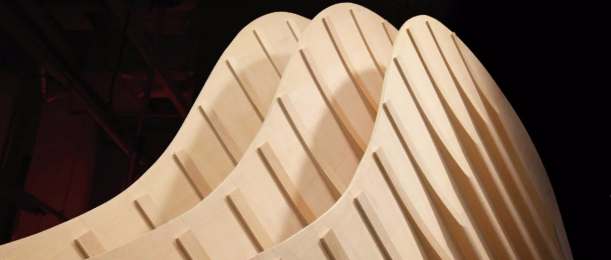
Typically made of spruce due to its excellent ratio of high elastic modulus to low density (high sound radiation efficiency). The anisotropy of the wood (grain direction) is crucial for vibration transmission.
Waveguide Effect: At high frequencies (above approximately 1.1kHz), the ribs act as waveguides, restricting the propagation of sound waves between them, leading to the "localization" of vibrational energy. This localization affects the sustain and radiation directivity in the treble range.
Stiffness Balancing:
At low frequencies, the ribs increase the stiffness of the soundboard across the grain, making its behavior more similar to an isotropic panel, which aids in overall resonance.
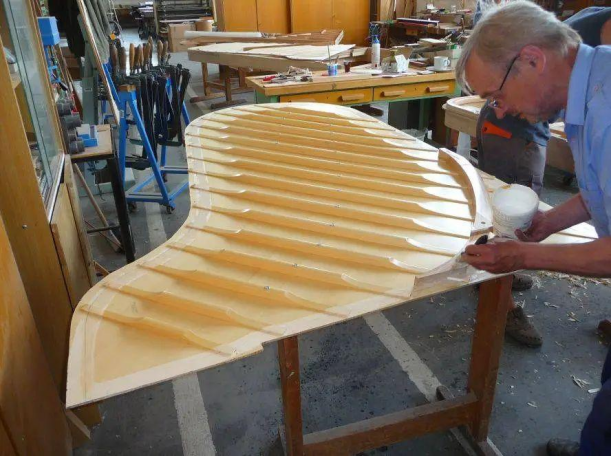
The soundboard is typically manufactured with a convex upward arch (crown). The strings exert downward pressure on the soundboard via the bridge (downbearing).
Balance: Excessive downbearing can restrict the soundboard's vibration, resulting in a loud but short-lived tone (sounding "choked"). Insufficient downbearing leads to a long sustain but a thin and weak tone. Proper downbearing is key to achieving good sustain and volume.
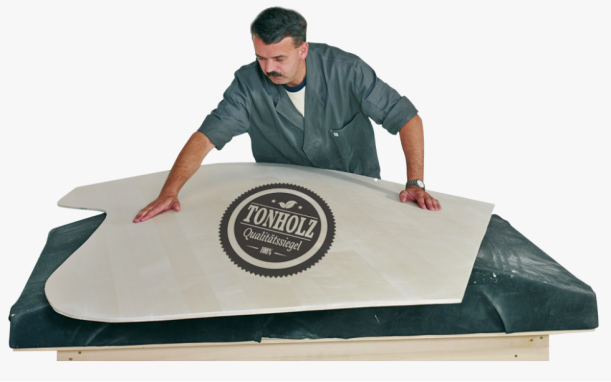
The mechanical impedance of the soundboard determines the rate at which energy flows from the strings. High impedance results in slow energy flow, leading to long sustain but low volume; low impedance results in high volume but rapid decay. Craftsmanship requires finding a balance between these two extremes.
In the range approximately from C6 to C7, a phenomenon of extremely short sustain or uneven tone often occurs. This is typically related to the impedance characteristics or modal localization of the soundboard in that specific region.





Mail:info@chlorispiano.com
Tel:86-18121133783
www.chlorispiano.com
技术支持:网新科技(www.ibw.cn) 沪IPC 备14053625号