Many piano technicians, when adjusting the action of a grand piano, are well aware that leveling the key height or the horizontal plane of the keys is the foundation for all subsequent adjustments and is a critically important step. However, in most regions of China, during the step of leveling the keys, many technicians adjust the keys to be perfectly horizontal. Yet, based on long-term practical experience, raising the center of the keyboard to create a slight arch is indeed a standard professional practice.
Let’s discuss the specific adjustment specification: set the middle E key approximately 1 mm higher than both ends, thereby creating a slight crown in the center of the leveled keyboard.
The principle, function, and advantages of this "1 mm higher in the middle" arch adjustment, compared to "absolute leveling," are mainly reflected in the following two aspects:
1. Resisting Material Compression and Localized Sinking from High-Frequency Use (Compensation in Advance)
The piano keyboard is a lever system, with felt and paper punchings placed beneath the keys for cushioning and height adjustment. In actual performance, the central section of the keyboard (the midrange) is used far more frequently than the extreme treble and bass registers. Over time, due to repeated high-intensity playing, the punchings under the midrange keys become compacted, causing the keys to sink.
Disadvantage of absolute leveling: If the keyboard is set to be perfectly flat during manufacturing or repair, after prolonged playing, the punchings in the midrange will compress, causing the center keys to become lower than the ends, resulting in an undesirable "dipped" shape.
Advantage of arched adjustment: The 1 mm slight crown acts as a mechanical allowance. It anticipates material fatigue and compression. As the most frequently used midrange punchings gradually compact, the originally higher keys will naturally sink, allowing the entire keyboard to become nearly level over an extended period of use.
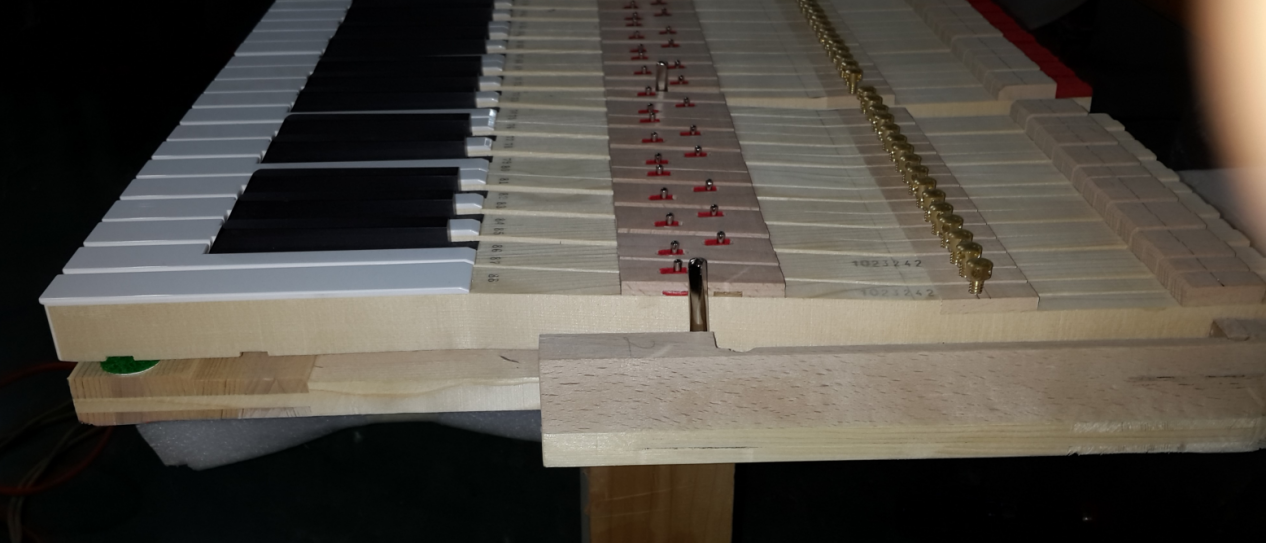
2. Compensating for Keybed Deformation to Prevent Shallow Touch
The keys rest on the keybed. The keybed supports the considerable weight of the action and the keyboard, and it may warp, deform, or sink due to environmental changes or stress.
·
If the keybed sinks in the middle, the balance rail supporting the keys will also lower. This directly reduces the key's key dip (touch depth), severely affecting the player's control over dynamics and tone.
Advantage of arched adjustment: Raising the middle E key by 1 mm not only visually and tactilely counters this potential sinking trend but also provides a mechanical buffer for the keybed. Even if the keybed experiences slight central sinking, this extra 1 mm ensures that the critical midrange keys do not immediately lose their proper key dip, maintaining a stable and even playing feel.
Setting the keyboard to be absolutely level may seem perfect in a static state, but it ignores the uneven wear and tear of the piano as a dynamic mechanism, as well as the deformability of wooden structures. The 1 mm crown in the center is a preventive measure against these inevitable physical changes, allowing the keyboard to maintain an ideal playing condition for longer.





Mail:info@chlorispiano.com
Tel:86-18121133783
www.chlorispiano.com
技术支持:网新科技(www.ibw.cn) 沪IPC 备14053625号