First of all, the answer is yes. The title of Bach's The Well-Tempered Clavier (original German: Wohltemperiertes Clavier) has been severely and widely misinterpreted throughout history.
This misinterpretation is primarily manifested in the erroneous equation of the term "Wohltemperierung" (well temperament) in the title with the modern "gleichschwebende Temperatur" (equal temperament).
More specifically, this misreading and its divergence from historical fact can be seen in the following core aspects:
A Long-Standing Historical Misunderstanding
The True Acoustic Meaning of "Wohltemperierung"
The Specific Historical Instrument Referred to by "Clavier"
Actually Composed for an Unequal Kirnberger-Style Temperament
Conclusion
In summary, to call this monumental work The Equal-Tempered Clavier is a profound historical misreading. It was not intended to promote equal temperament, which erases key colour, but is rather A Collection for the Fretted Clavichord in Unequal Well Temperament. Bach's original intention was to explore the musical expressiveness of all 24 major and minor keys within an unequal temperament that preserved the distinctive affective character of each tonality.
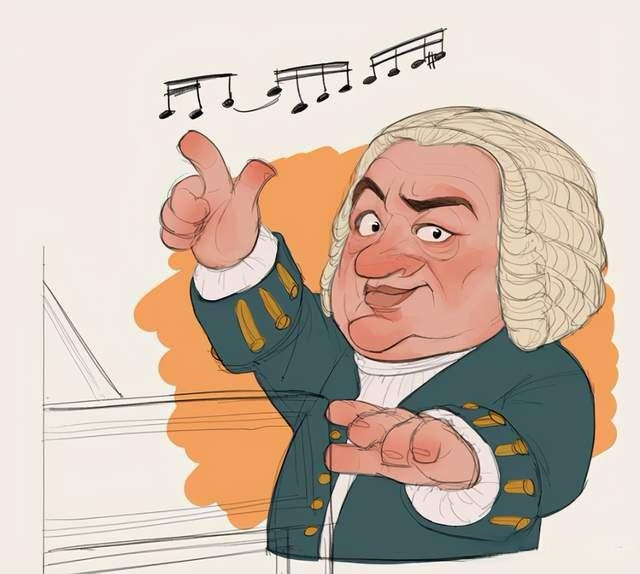
Beginning with the theorist Marpurg, an unverified and mistaken view circulated in academic circles, claiming that Bach's "well temperament" was equivalent to equal temperament. This view pervaded subsequent scientific and musicological literature for generations, with many scholars (such as Hermann Keller and Dupont) erroneously regarding the work as a "pioneering effort" for equal temperament or as a tool for its defence. However, research by modern scholars (such as Krüger) has shown that this dominant traditional view is fundamentally untenable.
In the context of Bach and his contemporaries (such as Werckmeister and Kirnberger), "well temperament" by no means referred to the division of the octave into twelve equal semitones. On the contrary, it denoted a mathematically and acoustically grounded tuning practice, rooted essentially in the "natural harmonic system" and striving "as far as possible to preserve the purity of natural intervals." This means that it was essentially an unequal temperament that retained a large number of pure harmonies.
The term "Clavier" in the title of Bach's Well-Tempered Clavier actually points to a specific keyboard instrument of the time—the "gebundenes Clavichord" (fretted clavichord). This type of clavichord had a fixed mechanical tangent layout. Research shows that forcibly imposing equal temperament on an instrument with such physical construction would not only create mechanical contradictions but would also amount to a "meaningless constraint" on the octave scales of each key.
Through statistical analysis of the tangent division positions on the fretted clavichord, researchers have reached a clear conclusion: Bach's Well-Tempered Clavier can only be a work for the fretted clavichord based on the principle of "ungleichschwebende Temperatur" (unequal temperament). Moreover, the tuning foundation on which this work relies is, in principle, consistent with the temperament system advocated by Bach's own direct disciple, Kirnberger.
Equal temperament robs music of its vitality primarily because, in pursuing mathematical equality, it forcibly flattens the inherent physical tensions and colouristic differences found in natural intervals, thereby undermining the music's inner means of emotional expression.
To perform early music composed on the basis of unequal temperaments on modern equal-tempered instruments is in fact to fundamentally alter and impair the original melodic and harmonic substance of the works.





Mail:info@chlorispiano.com
Tel:86-18121133783
www.chlorispiano.com
技术支持:网新科技(www.ibw.cn) 沪IPC 备14053625号